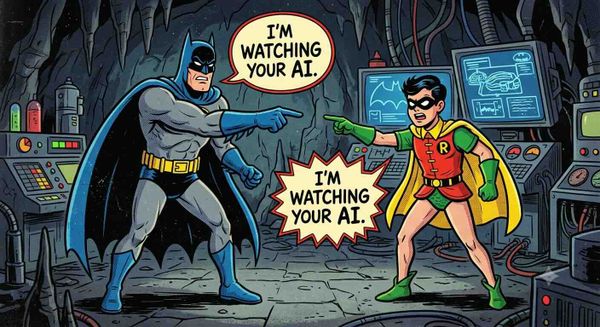
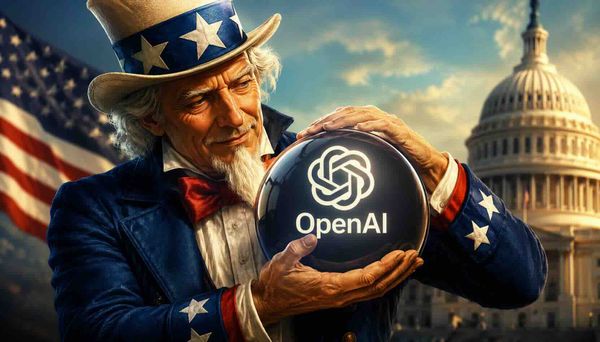
Your AI provider just became a single point of failure
Your AI provider is infrastructure now, and this week proved it. The continuity gap, Copilot's billing flip, and a rough week for security.

The Weekly Byte · June 19, 2026
Most of us spent years building redundancy into databases, regions, and CDNs. Almost nobody built it into the model layer. This week made the bill come due. Let's get into the next gap in your tech stack, which we didn't even consider until this week.
🔥Lead Story: The week AI continuity stopped being theoretical
On June 12, a US Department of Commerce export-control directive pulled Anthropic's restricted Mythos-class models, Claude Fable 5 and Claude Mythos 5, offline. Days later, they were still dark, and Anthropic had published its disagreement with the action without restoring access. Every team running those models in production lost them without warning and with no migration window. What bothers me is that the model was really good, and I was already migrating workflows to it.
Here is the part that should land for anyone running a business on top of an LLM. A recent Logicalis survey found that roughly 16 percent of organizations have no continuity plan at all if a key AI provider disappears. That number used to read like a compliance footnote. This week, it read like a forecast. The companies caught flat-footed are now scrambling to re-route workloads to Opus 4.8 or GPT-5.5 with no tested fallback and no timeline.
If you take one thing from this issue: model providers are infrastructure now, and infrastructure fails. Geopolitics, export rules, capacity, pricing, a single policy memo. The cause changes. The lesson does not abstract your provider behind an interface, keep a second model wired and tested, and know which workflows can degrade gracefully versus which ones simply stop. I have been saying this about cloud regions for a decade. It applies cleanly to the model layer, and the cost of ignoring it just got a public demo.
📰Top Stories
1. GitHub Copilot ditches flat pricing for token-based billing
As of June 1, Copilot moved off its flat monthly subscription and onto token-based billing. Heavy agentic users will feel this fast, because autonomous coding burns tokens at a very different rate than tab-completion ever did.
Why it matters: Your AI coding spend just became a variable line item that scales with usage, not a fixed seat cost. If you run an engineering team, you need cost visibility per developer and per repo before the first surprise invoice, not after!! Get ready for some new billing optimization startups in this space...
2. Gemini 3.5 Pro is days away, and it is aiming high
Google's Gemini 3.5 Pro is in its final stretch, with prediction markets clustering around late June. Confirmed specs include a 2 million token context window, a Deep Think reasoning mode, and frontier multimodal capability, at roughly 15 dollars per million input tokens and 60 per million output. Don't forget the recent Apple-Siri partnership, which may be available on our iPhones later this year.
Why it matters: A 2M context window changes what is feasible without retrieval plumbing: whole codebases, full contract sets, entire ticket histories in one shot. It also keeps real competitive pressure on pricing, which is good for everyone buying inference.
3. Devin now ships 89 percent of the code at its own company
Cognition raised a billion-plus Series D and disclosed that 89 percent of all code committed internally is now shipped by Devin, its autonomous software engineer. Revenue run rate went from 37 million in May 2025 to 492 million a year later, with Goldman Sachs, Mercedes-Benz, and NASA on the customer list.
Why it matters: Agentic coding crossed from demo to default at least somewhere real. Whether or not the 89 percent number generalizes, the direction is clear: the engineering manager's job is shifting from writing code to reviewing and directing agents that write it.
4. A brutal week for the software supply chain
The Shai-Hulud worm kept spreading across npm and PyPI after its source code was published publicly, turning a single criminal campaign into open tooling for copycats. Separately, researchers flagged 15 malicious plugins on the JetBrains Marketplace built to exfiltrate AI provider API keys, and Microsoft pulled dozens of its own open-source GitHub projects offline after attackers injected password-stealing malware.
Why it matters: The thing stealing credentials now is increasingly an AI API key, because that key unlocks spend and data. Lock down your dependency provenance, scope your keys tightly, and rotate. The blast radius of one compromised package is bigger than it was a year ago.
More: June 2026 Cybersecurity Review · Cyber Security Review
5. Cloud-native quietly grows up around AI workloads
Kubernetes and Cloud Native have taken a backseat to the AI hype. But fear not, the community is still active and shipped Kubernetes 1.36 with native GPU scheduling through Workload Aware Scheduling and DRA, OpenTelemetry graduated at the CNCF as the vendor-neutral standard for observability, and KubeCon India ran in Mumbai this week. Closer to home, Swisscom is pioneering a sovereign cloud built on open-source Kubernetes with KubeVirt and Kube-OVN.
Why it matters: The boring infrastructure layer is where AI economics get won or lost. GPU scheduling and real observability are the difference between an inference platform that pays for itself and one that quietly bleeds money. The Swisscom move also signals where European data-residency demand is heading.
🛠️Tool of the Week: OpenTelemetry
With its CNCF graduation(FINALLY) this month, OpenTelemetry is now the safe default for instrumentation. One vendor-neutral standard for traces, metrics, and logs that you can point at whatever backend you like, without rewiring every time you switch tools. The timely part: it is becoming the foundation for AI agent observability too, so the same pipeline that watches your services can watch your agents. If you are still locked into a proprietary agent, this is the week to plan the migration.
💡Quick Takes
- SoftBank committed up to 75 billion euros to build 5 gigawatts of AI data center capacity in France, Europe's largest single AI infrastructure bet.
- ChatGPT reportedly crossed one billion (yes, with a B) monthly active users.
- The IPO wave is real: SpaceX, Anthropic, and OpenAI are lining up to take 2026 AI-related IPO proceeds toward a projected 160 billion dollars.
- Fortinet exposure: credentials for roughly 75,000 FortiGate devices are being sold, harvested from a still-live campaign. Patch and rotate.
- Colorado's AI Act takes effect June 30 and is not suspended by the stalled federal bill. If you sell into the US, the clock is real.
- Microsoft Patch Tuesday hit a record near 200 vulnerabilities, followed hours later by an unpatched Windows Defender zero-day.
📊 Numbers That Matter
| Metric | Value | Context |
|---|---|---|
| Orgs with no AI continuity plan | 16% | No plan B if a key provider goes dark; this week proved the risk. |
| Cognition code shipped by an agent | 89% | All internal commits now shipped by Devin. |
| Gemini 3.5 Pro context window | 2,000,000 | Confirmed token window for the upcoming release. |
| Container workloads on Kubernetes | 82% | Now running in production, per CNCF. |
| AI startup funding, Q1 2026 | $242B | About 80 percent of all global venture funding. |
| Packages hit by Shai-Hulud | 100+ | Latest supply chain wave across npm and PyPI. |
Brian's Take
There is one thread running through every story this week, and it is not a model release. It is that AI has fully entered production infrastructure, and most teams are still treating it as an experiment.
When Fable 5 went offline, the teams that suffered were not the ones with the wrong model. They were the ones with one model and no plan B. When Copilot's billing flipped, the teams that flinched were the ones with no usage visibility. When the supply chain got hit, the keys that mattered were the AI keys nobody had scoped down. Same lesson, three times in one week.
So the homework is unglamorous and exactly the kind of thing that separates operators from vibe coders. Abstract your AI provider. Wire and test a fallback model. Put cost visibility on your AI spend before the invoice surprises you. Scope and rotate your keys.
See you next Friday. Brian
The Weekly Byte covers AI, DevOps, cloud-native infrastructure, and security for people who ship. Forward it to someone who should be reading it.