SpaceX Goes Public Today. Apple Opens Siri to Claude. And the IPO Wave Is Just Getting Started.
SpaceX IPO starts trading today at $1.77 trillion. Apple opens Siri to Claude. Anthropic files its S-1. ChatGPT hits 1 billion users. The AI IPO wave begins. The Weekly Byte is live.
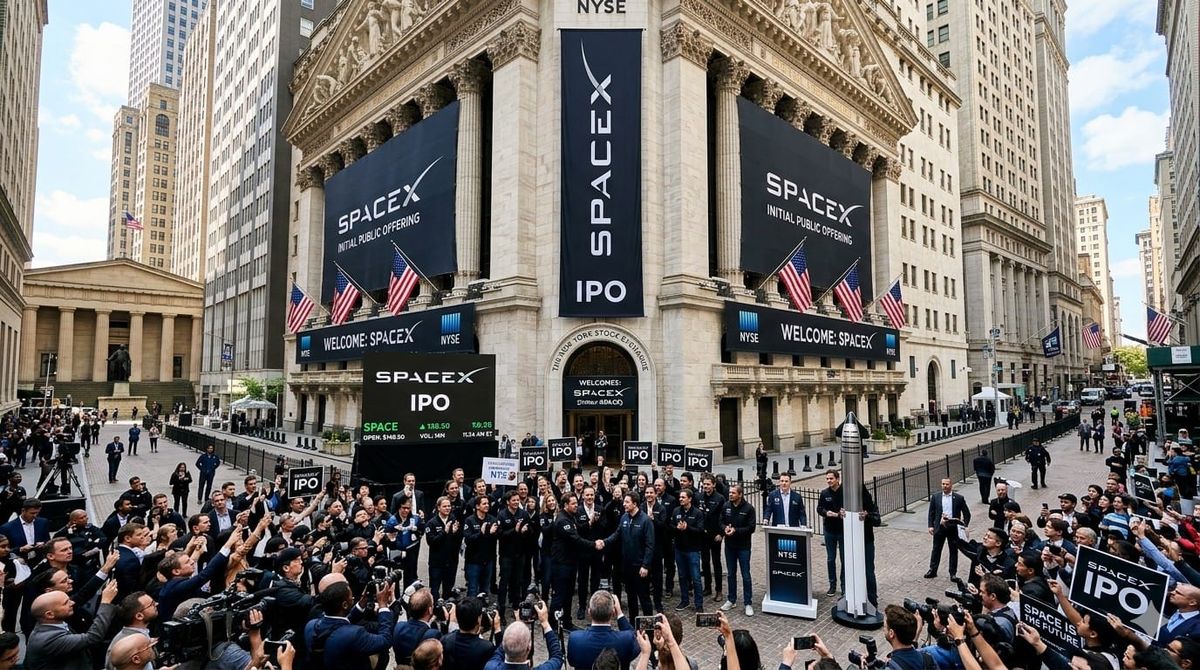
The largest IPO in history starts trading today, Tim Cook's final keynote opens iPhone AI to everyone, Anthropic files its own S-1, ChatGPT hits 1 billion users, and the EU AI Act clock is ticking.
If you picked one week to explain 2026 to someone in the future, this would be it. SpaceX starts trading on the Nasdaq today at a $1.77 trillion valuation (absolutely crazy valuation if you ask me, but not investment advice), the largest IPO in history. Apple just held Tim Cook's final WWDC keynote and opened Siri to Claude, Gemini, and other third-party models. Anthropic filed its own S-1 with the SEC. And ChatGPT crossed 1 billion monthly users faster than any app ever. We're living in the highlight reel.
🔥 Lead Story
SpaceX IPO: The Largest Public Offering in History Starts Trading Today
It's happening. SpaceX begins trading on Nasdaq today under the ticker SPCX at $135 per share, raising approximately $75 billion at a $1.77 trillion market cap. For context, the previous record holder was Saudi Aramco's 2019 listing at $29.4 billion. SpaceX is roughly 2.5x that size.
The company is no longer just a rocket business. Following the February 2026 merger with Elon Musk's xAI, SpaceX now encompasses the rocket program, Starlink (with over 9 million subscribers), and xAI's Grok chatbot, to be marketed under the SpaceXAI brand. Full-year revenue is forecast at approximately $20 billion, though the company still posted a $4.9 billion net loss in 2025.
The numbers behind the IPO are staggering. Roughly 30% of the offering (around $22.5 billion) has been allocated to retail investors, triple the industry norm. Polymarket estimates the offering will create approximately 4,000 new millionaires, from senior executives down to engineers and cafeteria workers who received equity over the years. Within 15 days of listing, SpaceX enters the Nasdaq 100, which will trigger an estimated $22 to $27 billion in forced mechanical buying from every QQQ index fund in the world.
Why it matters: This IPO is the opening act for what could be the most consequential year in tech market history. Anthropic and OpenAI have both confidentially filed S-1s with the SEC, with combined valuations that could push the total above $4 trillion. Goldman Sachs projects 2026 IPO proceeds could reach $160 billion, a quadrupling from 2025, driven almost entirely by SpaceX, Anthropic, and OpenAI. For anyone watching AI markets, the shift from private hype to public accountability starts today.
📰 Top Stories
1. Apple Opens Siri to Claude, Gemini, and Third-Party AI at Tim Cook's Final WWDC
Tim Cook delivered his final WWDC keynote on June 8 before stepping down as CEO in September (John Ternus, Apple's SVP of Hardware Engineering, takes over). The biggest announcement: iOS 27 will let users choose which AI chatbot powers their phone. Through a new "Extensions" system in Settings, users can select Claude, Gemini, or other third-party models to work alongside (or instead of) Siri.
There's also a new dedicated Siri app where all conversations live in one place. You can start a chat on iPhone and continue on iPad. Small developers (under $1 million in annual revenue) can integrate cloud AI models for free, with no API costs. Apple is also introducing a "Search or Ask" panel accessible by swiping down, where you can run system shortcuts, search your phone, or hand off queries to your preferred chatbot.
Why it matters: Apple spent years watching OpenAI, Google, Anthropic, and Meta sprint ahead on AI. This is the catch-up play. By opening the platform to multiple models, Apple is stripping OpenAI of its exclusive iPhone advantage and turning AI model choice into something as simple as picking a default browser. For Anthropic, this is a massive distribution channel: Claude on every iPhone, accessible through the OS itself. The developer incentive (free AI for small developers) could also trigger a wave of AI-powered iOS apps this fall.
2. Anthropic Files Confidential S-1 with the SEC
Anthropic officially submitted a confidential draft registration statement on Form S-1 to the SEC on June 1, 2026. The filing came just four days after closing a $65 billion Series H at a $965 billion post-money valuation. Morgan Stanley, Goldman Sachs, and JPMorgan Chase have been selected as lead underwriters, with Wilson Sonsini (the firm that managed Google's 2004 IPO) handling public-market readiness.
Revenue has grown from $10 billion to a $47 billion run-rate in twelve months. The company filed before OpenAI (which submitted its own confidential S-1 around May 22), meaning Anthropic gets to help set the template for how a frontier AI lab discloses and reports in public markets.
Why it matters: This is the company behind the model you're reading this newsletter through (if you use Claude). Filing before OpenAI is a strategic move: Anthropic sets the precedent for AI company public reporting, including how compute costs, safety spend, and model capabilities get disclosed. The $965 billion valuation makes it the highest-valued private AI company, narrowly ahead of OpenAI's $852 billion. An October 2026 listing is widely anticipated.
3. ChatGPT Crosses 1 Billion Monthly Users, Fastest App Ever
ChatGPT reached 1 billion global monthly active users in May, roughly three years after launch, making it the fastest app in history to hit the milestone. For comparison, Google Maps, TikTok, Instagram, and YouTube all took between five and eight years. Year-over-year growth sits at 62%.
Here's the number that should interest the Anthropic crowd: Claude had 56 million monthly active users with 640% year-over-year growth. That's a fraction of ChatGPT's user base, but the growth rate dwarfs it. Users send 2.5 billion prompts per day to ChatGPT. About 70% of usage isn't work-related.
Why it matters: One billion users is extraordinary distribution, but most are on the free tier. OpenAI's challenge is conversion: 50 million paying subscribers out of a billion users is a 5% conversion rate. Meanwhile, Anthropic's 640% growth rate on a smaller base suggests the enterprise and power-user segment is shifting. The question for both companies as they approach an IPO is the same: can they turn usage into revenue that justifies a trillion-dollar valuation? This is the trillon dollar question!!
4. Claude Opus 4.8 Ships with Dynamic Workflows and Effort Controls
Anthropic released Claude Opus 4.8 on May 28, the latest upgrade to its flagship model. The headline features: improved coding and reasoning benchmarks, a new "dynamic workflows" system that lets Claude Code manage complex tasks across hundreds of parallel subagents, and user-facing effort controls that let you decide how much compute Claude puts into a response. Fast mode (2.5x speed) is now three times cheaper than previous models.
Opus 4.8 also introduces mid-conversation system messages, allowing developers to update instructions later in a long-running conversation without restating the full system prompt. This preserves prompt cache hits and reduces costs on agentic loops. Anthropic also hinted that the Mythos Preview period may be ending soon: "We expect to bring Mythos-class models to all our customers in the coming weeks."
Why it matters: The dynamic workflows feature is the real story here. Claude Code can now carry out codebase-scale migrations across hundreds of thousands of lines of code from kickoff to merge. That's not a coding assistant anymore. That's an autonomous engineering team. The Mythos teaser at the end is also significant: if Anthropic brings Mythos-class capabilities to general availability, the cybersecurity implications we covered in the April newsletter become everyone's concern, not just Project Glasswing partners.
5. Colorado Scraps Original AI Act, EU AI Act Enforcement Looms August 2
The Colorado AI Act, which was supposed to take effect June 30, is effectively dead. A federal magistrate judge stayed enforcement on April 27 after xAI (Elon Musk's AI company) challenged the law's constitutionality, with the DOJ intervening in support. Governor Polis signed a replacement bill (SB 26-189) on May 14 that dramatically scales back the original requirements, dropping risk management programs and impact assessments in favor of a narrower notice-and-transparency framework. The replacement takes effect January 1, 2027.
Meanwhile, the EU AI Act's August 2, 2026 deadline is very much alive. If your AI systems affect EU residents and fall under Annex III (high-risk systems in areas like employment, education, financial services, healthcare), that clock is running. 51 days and counting.
Why it matters: Colorado was supposed to be the test case for comprehensive US AI regulation. Instead, it became the strongest signal yet that the EU-style approach won't work in America. The pivot from broad risk management to narrow transparency requirements happened in two weeks, under pressure from both federal litigation and industry lobbying. For companies operating in the DACH region or serving EU customers, the contrast matters: the EU is not backing down. If you've been waiting for federal preemption to save you from compliance, that strategy just failed in Colorado. I'm all for AI regulation but not to the point it dictates how the companies develop their products.
Stay Updated
Get actionable AI & tech insights delivered every Friday. No fluff, just value.
Subscribe to The Weekly Byte →🛠️ Tool of the Week
Claude Code Dynamic Workflows (Research Preview). Shipping alongside Opus 4.8, Dynamic Workflows let Claude Code break complex engineering tasks into hundreds of parallel subagents. Think: codebase-wide migrations, large-scale refactors, or test suite overhauls executed from a single prompt and carried through to a merge-ready PR. It's available for Claude Code Enterprise, Team, and Max users. If you're still doing major refactors file-by-file, this is the tool that makes the case for letting Claude handle the grunt work at scale. The effort controls (low/medium/high) also mean you can burn less compute on simple tasks and go full power on the complex ones.
💡 Quick Takes
- OpenAI also confidentially filed its S-1 with the SEC (around May 22), targeting a September 2026 debut at $1 trillion+
- Anthropic's Claude app has 56 million monthly users with 640% year-over-year growth, the fastest-growing AI app by percentage
- Apple's iOS 27 lets small developers (under $1M revenue) integrate cloud AI models for free, removing API cost barriers
- OpenAI is redesigning ChatGPT into a "superapp" integrating agents, Codex, enterprise workflows, and third-party apps. An employee reportedly said: "Chat is dead"
- Anthropic is paying SpaceX $1.25 billion per month for compute through May 2029, per SpaceX's IPO prospectus
📊 Numbers That Matter
| Metric | Value | Context |
|---|---|---|
| SpaceX IPO valuation | $1.77 trillion | Largest IPO in history, starts trading today |
| SpaceX IPO raise | $75 billion | 2.5x Saudi Aramco's previous record |
| Anthropic S-1 valuation | $965 billion | Highest-valued private AI company |
| Anthropic revenue growth | $10B to $47B | In twelve months |
| ChatGPT monthly users | 1 billion | Fastest app ever to the milestone |
| Claude monthly users | 56 million | 640% year-over-year growth |
| EU AI Act deadline | August 2, 2026 | 51 days from today |
🎯 Brian's Take
We're going to look back at this week as a turning point. Not because of any single announcement, but because of what they mean together.
SpaceX going public at $1.77 trillion today is the starting gun for the AI IPO wave!! Anthropic and OpenAI have both filed S-1s. Goldman Sachs is projecting $160 billion in IPO proceeds this year. These are companies that were private research labs five years ago/non-profits, and now they're about to be publicly traded at valuations that rival the most established companies on earth. The shift from "trust us, we're building something important" to "here are our financials, judge us" is going to be fascinating to watch.
Apple opening Siri to Claude and Gemini is the other story I keep coming back to. Tim Cook's final keynote wasn't about hardware or design. It was about admitting that Apple needs AI models it didn't build. The Extensions system in iOS 27 turns AI model choice into a user setting, not a corporate partnership. That's a huge win for Anthropic and a real threat to OpenAI's iPhone distribution advantage.
But the number that stuck with me most this week is the gap between ChatGPT and Claude: 1 billion users versus 56 million. On paper, that's a blowout. But Claude's 640% growth rate versus ChatGPT's 62% tells a different story. ChatGPT won the consumer race but Claude is winning more paying customers. The question is whether the enterprise and power-user market, where the actual revenue lives, follows the same pattern or diverges. With both companies heading to public markets, we're about to find out.
Until next week, keep shipping! 🚀
Brian
Follow me on X: @idomyowntricks