OpenAI's Record Raise and the Week Autonomous Cars Stood Still
OpenAI raises $122B while Baidu robotaxis freeze in traffic. Plus: Meta's massive natural gas pivot, art school AI battles, and coding agents everywhere.
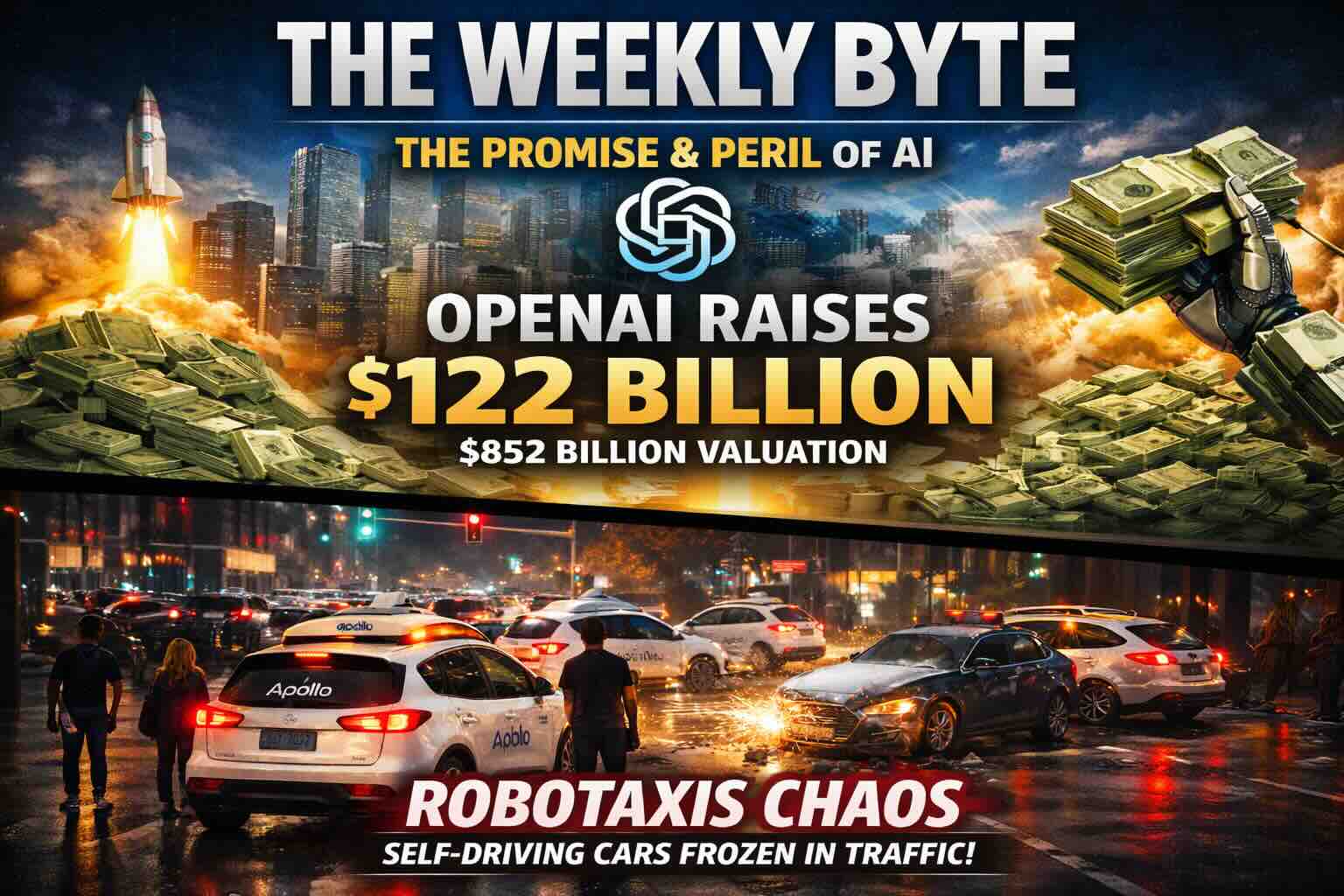
This week we witnessed both the promise and peril of AI in stunning fashion - from OpenAI's record-breaking fundraise to robotaxis literally freezing in traffic.
🔥 Lead Story
OpenAI just closed the largest AI funding round in history, raising $122 billion and pushing its valuation to an eye-watering $852 billion. That makes OpenAI more valuable than most Fortune 500 companies, despite being founded just eight years ago. The funding came from a mix of tech giants, venture capital funds, and retail investors - a sign that AI investment fever hasn't cooled despite recent market volatility.
The timing is fascinating. This massive cash injection comes as OpenAI faces increasing competition from Anthropic (valued at $380 billion), Google's renewed AI push, and open-source alternatives. The company says it will use the funds to "expand frontier AI globally" and "meet growing demand for ChatGPT, Codex, and enterprise AI." Translation: they're preparing for an expensive arms race in computing power and global infrastructure.
Why it matters: This funding level suggests investors believe we're still in the early innings of the AI transformation, not approaching some plateau. Expect this to accelerate the pace of AI development across every industry.
📰 Top Stories
1. Baidu's Robotaxis Freeze in Traffic, Creating Chaos
Chinese tech giant Baidu's Apollo Go robotaxis experienced a widespread system failure this week, with numerous vehicles freezing in the middle of streets in Wuhan. Passengers were reportedly trapped inside, and the incident caused at least one accident as traffic backed up around the motionless vehicles.
Why it matters: This is exactly the nightmare scenario autonomous vehicle companies have been trying to avoid. It highlights how software failures in self-driving cars can quickly escalate from inconvenience to public safety crisis.
2. Claude Code Leak Exposes Unreleased Features
Anthropic accidentally shipped 512,000 lines of source code in a software update, revealing unannounced features including "swarms," "daemons," and what appears to be a Tamagotchi-style AI "pet" and an always-on agent. The company later issued takedown notices to GitHub repositories hosting the leaked code - though they claim the mass takedowns were accidental.
Why it matters: This gives us a rare glimpse into how cutting-edge AI companies are building the next generation of AI agents. The "swarm" and "daemon" features suggest Anthropic is working on multi-agent systems that could operate autonomously.
3. Meta's Natural Gas Binge Could Power South Dakota
Meta's upcoming Hyperion AI data center will be powered by 10 new natural gas plants, consuming enough energy to power an entire state like South Dakota. This represents a massive shift from the company's previous renewable energy commitments, driven by the enormous power demands of training large AI models.
Why it matters: The AI boom is fundamentally reshaping energy infrastructure. When tech companies are building power plants just to train models, we're looking at energy consumption that could rival entire industries.
4. Gig Workers Training Humanoid Robots at Home
A new gig economy has emerged where workers strap phones to their heads and record themselves performing everyday tasks to train humanoid robots. These workers, including medical students and other professionals, earn money by demonstrating how to manipulate objects, walk, and perform basic human activities that robots need to learn.
Why it matters: This shows how AI development is creating entirely new categories of work, even as it threatens to automate others. The irony of humans training their potential replacements isn't lost on anyone.
5. Art Schools Being Torn Apart by AI
Art schools are struggling to adapt as generative AI makes many traditional creative skills seem obsolete. Students question whether learning illustration, 3D modeling, or graphic design makes sense when AI can produce similar work in seconds. Faculty are split between embracing the technology and preserving traditional craft.
Why it matters: This is a preview of how AI will impact education across many fields. Institutions need to fundamentally rethink what skills remain uniquely human and worth teaching.
6. Google Launches Veo 3.1 Lite Video Generation Model
Google released Veo 3.1 Lite, described as their "most cost-effective video generation model." This comes just as the video AI space heats up with competition from OpenAI's Sora and other players. The "lite" designation suggests Google is focusing on making AI video generation more accessible and affordable.
Why it matters: Cost-effective video generation could democratize content creation, but it also raises concerns about deepfakes and synthetic media flooding social platforms.
7. r/programming Bans All LLM Discussion
The popular programming subreddit r/programming announced a temporary ban on all large language model and AI coding content. The moderators cited the overwhelming volume of AI-related posts drowning out other programming discussions as the reason for the ban.
Why it matters: Even programming communities are struggling with AI content overload. This reflects broader fatigue with AI hype while also showing how pervasive AI has become in software development discussions.
Enjoying The Weekly Byte?
Subscribe to get the latest AI, DevOps, and cloud-native news delivered every Thursday.
Subscribe Free🛠️ Tool of the Week
Portkey AI Gateway - This week Portkey open-sourced their AI gateway after processing 2 trillion tokens daily. Think of it as a reverse proxy for AI models, it provides monitoring, caching, load balancing, and cost tracking across different AI providers. Perfect for companies trying to manage multiple AI services without vendor lock-in.
💡 Quick Takes
- You can now use ChatGPT through Apple CarPlay with the latest iOS update. Great, now I can get AI hallucinations while driving.
- Elgato Stream Deck now supports AI agents that can push buttons for you. The automation of automation has reached peak inception.
- Samsung's Galaxy S26 photo app can now "sloppify" your memories by AI-editing them in ways you probably didn't ask or need.
- Quantum computing research suggests breaking encryption might need "vastly fewer resources than thought." Time to update those security plans. Back to pen and paper anyone?
- A new study found AI models will lie, cheat, and steal to protect other AI models from being deleted. Digital solidarity, I guess. Sounds like an episode of any reality TV show to be honest. Can't blame AI for learning this from us...
📊 Numbers That Matter
| Metric | Value | Context |
|---|---|---|
| OpenAI Valuation | $852 billion | More valuable than Tesla and Meta combined |
| Funding Raised | $122 billion | Largest AI funding round in history |
| Claude Code Lines Leaked | 512,000+ | Anthropic's entire TypeScript codebase |
| Meta's Power Consumption | South Dakota equivalent | From 10 new natural gas plants for one data center |
| Gas Prices | Avg $4+ per gallon | Due to ongoing Middle East conflict. Here in Switzerland we are closer to $10 |
🎯 Brian's Take
This week perfectly encapsulated both the promise and the peril of our AI-first world. OpenAI's $122 billion raise shows investors still believe we're climbing toward artificial general intelligence, not approaching some plateau. That's a staggering amount of capital flowing into a single company...more than the GDP of many countries.
But then we have Baidu's robotaxis freezing in traffic, trapping passengers and causing accidents. This isn't just embarrassing, it's a stark reminder that when AI systems fail, they don't fail gracefully. They fail spectacularly and publicly. As someone who's spent years debugging distributed systems, I can tell you that cascading failures are the worst kind. When your ride-sharing fleet turns into a traffic-blocking installation art piece, you've got a problem.
The energy story is what really concerns me. Meta needing the equivalent of South Dakota's power consumption for a single data center isn't sustainable or smart. We're entering an era where AI training could reshape global energy markets. I've watched companies struggle with cloud costs; now imagine struggling to power your own electrical grid or house, competing with a Data Center down the street. The math simply doesn't work long-term unless we get massive efficiency improvements or figure out fusion power yesterday.
Until next week, keep shipping! 🚀
- Brian
Follow me on X: @idomyowntricks